
Surgical Scissors Explained: Patterns, Materials and How to Choose the Right Pair
Surgical scissors are among the most frequently used — and most frequently misspecified — instruments in any operating theatre, treatment room or teaching lab. A single procedure can call for two or three different scissor patterns, each doing a distinct job: opening tissue planes, trimming suture, cutting dressing material, or dividing wire. Choosing the wrong pattern does not just slow a procedure down — it can damage tissue, blunt an edge meant for something else entirely, or force staff to improvise with an instrument that was never designed for the task at hand.
This guide sets out the practical differences between the surgical scissor patterns hospitals, clinics and training institutions purchase most often, explains how blade shape and tip design map to specific clinical tasks, and gives procurement staff a framework for standardising scissor selection across departments rather than reordering ad hoc.
- What Are Surgical Scissors?
- Anatomy of a Surgical Scissor
- Common Patterns Explained: Mayo, Metzenbaum, Iris and More
- Blade Tips and Edge Types
- Materials and Finish: Stainless Steel and Tungsten Carbide
- Choosing the Right Scissors for the Procedure
- Sizing and Ergonomics
- Care, Sterilization and Maintenance
- Common Mistakes When Selecting Surgical Scissors
- Institutional Procurement Considerations
- Frequently Asked Questions
What Are Surgical Scissors?
Surgical scissors are precision cutting instruments designed for specific tasks within a sterile field: dissecting tissue planes, cutting suture material, trimming dressings, or dividing wire and other non-tissue materials. Unlike household or office scissors, surgical scissors are engineered around the particular resistance, thickness and fragility of the material they are meant to cut. A pair designed to glide through delicate connective tissue will perform poorly — and may be damaged — if used to cut heavy suture or wire, and vice versa.
Because the wrong scissor can compromise both the instrument and the tissue, most operating theatres and teaching institutions maintain several scissor patterns as standard rather than relying on a single general-purpose pair. Understanding what separates one pattern from another is the first step in specifying the right set for a given department, procedure list or training curriculum.
Anatomy of a Surgical Scissor
Every surgical scissor is defined by four structural choices, and understanding them makes the rest of this guide easier to apply:
Blade profile — straight or curved. Straight blades give a direct line of sight and are typically used for surface-level or superficial work. Curved blades allow the surgeon to work around structures and maintain visibility of the cutting edge in a confined or deep surgical field.
Tip design — sharp or blunt, in either combination (sharp/sharp, sharp/blunt, blunt/blunt). Tip design determines how safely the scissor can be introduced into a tissue plane without risking inadvertent injury to adjacent structures.
Handle style — ring-handled (finger-ring, the traditional design) or bayonet/pistol-grip, which offsets the handle from the blade axis for better visibility in deep or narrow surgical fields, common in ENT and ophthalmic work.
Blade length and overall length — shorter, finer instruments for superficial or delicate work; longer instruments for deeper access. Overall length is typically specified in inches (commonly 4.5" to 9" for general surgical use).
Common Patterns Explained: Mayo, Metzenbaum, Iris and More
Most surgical scissor purchasing decisions come down to a handful of recognisable patterns, each with a well-established clinical role. Many of these names are eponyms — named after the surgeon or institution associated with popularising the design — which is worth knowing because the same pattern is sometimes ordered under a slightly different name depending on the supplier catalogue.
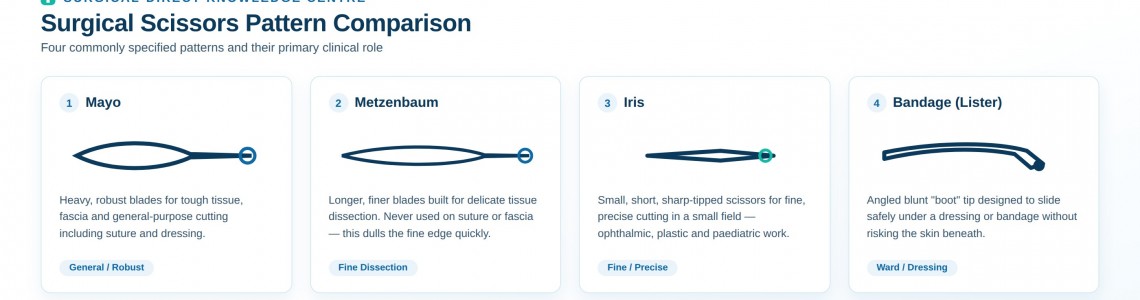
Mayo scissors — heavy, robust blades (straight or curved) designed for cutting tough tissue such as fascia, and for general-purpose cutting tasks including suture and dressing. Named after the Mayo Clinic, where the pattern was popularised, Mayo scissors are the general workhorse of a surgical tray and are typically the first pattern any general surgery set includes. The straight variant is generally reserved for surface-level cutting and suture, while the curved variant allows tissue work around a corner without losing sight of the blade tips.
Metzenbaum scissors — longer, finer and more delicately balanced than Mayo scissors, with thinner blades designed for cutting and dissecting delicate tissue rather than tough or fibrous material. Named after American surgeon Myron Metzenbaum, this pattern is a staple of any procedure involving fine dissection — vascular, gynaecological and general soft-tissue work in particular. Metzenbaum scissors should never be used on suture or heavy tissue, as this rapidly dulls the fine edge they depend on; a Metzenbaum pair pressed into the wrong role is one of the most common causes of premature instrument wear on a surgical tray.
Iris scissors — small, short, sharp-tipped scissors originally developed for ophthalmic iris surgery but now used broadly wherever fine, precise cutting is required in a small field — plastic surgery, microsurgery, paediatric procedures and delicate suture trimming. Their short blade length trades reach for precision, which is exactly the trade-off needed when working within a few millimetres of a delicate structure.
Tenotomy scissors — a further refinement of the fine-scissor family, typically longer and thinner than Iris scissors, designed originally for tendon release procedures and now used across plastic surgery and delicate dissection wherever a longer reach combined with a very fine tip is needed.
Bandage (Lister) scissors — recognisable by an angled blunt "boot" tip designed to slide safely under a dressing or bandage without risking the skin beneath. Named after 19th-century surgeon Joseph Lister, these are a dressing-room and ward staple rather than a sterile-tray instrument in most departments, and are sized and priced accordingly — there is rarely a case for the same tungsten-carbide or premium finish used on a theatre instrument.
Suture scissors — straight scissors, often with one serrated blade for grip, used specifically for cutting suture material at the correct length without fraying the knot. A dedicated suture scissor protects the finer edge of a Metzenbaum or Iris pair from being pressed into a job that will blunt it.
Wire scissors / wire-cutting scissors — reinforced, heavy-duty blades specifically hardened to cut orthopedic or surgical wire without damaging finer instruments that are not designed for this load. These typically carry a distinct, more angular blade profile than tissue-cutting scissors, reflecting the different mechanical demands of cutting metal rather than soft tissue.
A well-specified general surgery set typically includes at least a Mayo and a Metzenbaum pair as standard, with Iris, bandage and suture scissors added depending on the procedure mix. Our Surgical Sets range, including Medical Surgery Sets, is configured around exactly this logic — a matched combination of patterns for a defined procedure type, rather than a single generic scissor doing every job.

Scissors Across Surgical Specialties
While the core patterns above are broadly consistent across departments, how they are combined and specified shifts by specialty. General and abdominal surgery relies heavily on the Mayo/Metzenbaum pairing described above, typically in mid-to-long lengths for adequate reach into the abdominal or thoracic cavity. Ophthalmic surgery, by contrast, works almost exclusively with very short, very fine instruments — Iris and Westcott-type spring scissors — reflecting a surgical field measured in millimetres rather than centimetres.
ENT and otologic procedures typically favour bayonet-handled variants of both fine and general scissors, since the offset handle keeps the surgeon's hand and wrist out of the direct line of sight down a narrow ear or nasal passage — the same logic behind bayonet-handled forceps discussed in our ENT Surgical Instruments guide. Orthopedic procedures introduce a further category entirely — heavy wire and tissue scissors built to a different mechanical specification than anything used in soft-tissue surgery, since cutting through periosteum, wire or occasionally cast material demands considerably more blade strength.
Dental and oral surgery settings typically need only a small subset of these patterns — usually a short Iris-type pair for soft tissue and a suture scissor — reflecting a smaller and shallower working field than general surgery, but with the same requirement for a sharp, well-maintained edge.
Blade Tips and Edge Types
Beyond pattern, the tip combination of a pair of scissors materially changes what it is safe and effective to do with it:
Sharp/sharp — both tips pointed, giving precise, controlled cutting at the very tip of the blade. Used where accuracy at a fine point matters more than safety margin, typically under direct vision in a controlled field.
Sharp/blunt — one pointed tip and one rounded tip, a common compromise that allows controlled entry into a tissue plane on the sharp side while the blunt side protects underlying structures.
Blunt/blunt — both tips rounded, the safest configuration for blunt dissection or for working near delicate structures (vessels, nerves, bowel) where an inadvertent puncture would be a serious complication.
Blade edge finish is a second, related variable: standard edges suit tissue and general cutting, while serrated edges (typically found on one blade of a pair) improve grip on slippery material such as suture, reducing slippage without needing more cutting force.

Materials and Finish: Stainless Steel and Tungsten Carbide
Surgical scissors are manufactured predominantly from surgical-grade stainless steel, typically in the 410 or 420 series. The two grades are often discussed interchangeably but differ in a way that matters for instrument selection: 410-series steel has a lower carbon content, giving it better corrosion resistance at a modest cost to maximum hardness, while 420-series steel carries higher carbon content, allowing it to be hardened further and hold a finer edge for longer, at a very slightly increased sensitivity to corrosion if cleaning protocols are not followed correctly. In practice, both grades perform well under correctly managed sterile processing, and the choice between them is usually made by the manufacturer at the design stage rather than specified by the purchasing institution.
For instruments subject to particularly heavy use — cutting suture repeatedly through a long procedure list, for example — tungsten carbide inserts are often fitted to the cutting edges. Tungsten carbide is significantly harder than stainless steel, and inserts of it embedded at the cutting edge hold a working edge considerably longer between sharpenings, at the cost of a higher unit price. Tungsten-carbide-inserted instruments are usually marked with gold-coloured handles or rings, a widely used visual convention that lets theatre staff identify them at a glance during a busy case.
Institutions weighing up standard stainless steel against tungsten-carbide-inserted instruments should factor in usage volume: a scissor used in every case on a busy list will earn back the price difference in extended service life and fewer replacement cycles, while a rarely used specialty pattern may not need the upgrade. Blade finish is a related, smaller decision — a satin or matte finish reduces glare under operating lights compared with a high-polish mirror finish, a minor but genuine factor in surgeon comfort over a long list. For a fuller comparison of these two material choices across the wider instrument range, see our TC Range category.
Choosing the Right Scissors for the Procedure
In practice, matching scissors to procedure comes down to answering three questions: what tissue or material is being cut, how deep or confined is the surgical field, and how much precision does the task demand at the tip.
General and abdominal surgery calls for a robust combination — Mayo for tough tissue and general cutting, Metzenbaum for finer dissection once the surgical plane is open. ENT and ophthalmic procedures favour bayonet-handled and Iris patterns, where an offset handle and a fine tip preserve the surgeon's view of a small working field — a logic explored in more depth in our ENT Instruments category and its accompanying ENT Surgical Instruments guide. Dressing changes and ward-level wound care call for bandage scissors with a blunt boot tip, kept entirely separate from the sterile tray. Suture removal and trimming, wherever it occurs in a procedure, is best served by dedicated suture scissors rather than pressing a Metzenbaum or Iris pair into a role that will dull its fine edge.
Training programmes should mirror this same logic rather than issuing a single generic scissor per student — part of why our Student Surgical Kits are configured around the same procedure-matched pattern combinations used in working theatres, so students build instrument familiarity that transfers directly into clinical practice.
Sizing and Ergonomics
Overall length affects both reach and control. A shorter instrument (around 4.5"-5.5") gives finer control for superficial or delicate work and is typical of Iris and many ophthalmic patterns. Mid-length instruments (around 5.5"-7") cover most general surgical use. Longer instruments (7"-9" and beyond) are reserved for deep cavity access, where the extra length trades off some tactile feedback for reach.
Handle design also affects fatigue over a long procedure list. Ring-handled scissors distribute grip load across the fingers and thumb and remain the standard for most general use; bayonet and pistol-grip handles reduce hand and wrist strain in procedures requiring the instrument to be held at an angle for extended periods, at the cost of a slightly different grip technique that takes time to become second nature.
Care, Sterilization and Maintenance
Surgical scissors are precision instruments, and their working life depends heavily on how they are cleaned, inspected and sterilized between uses. Instruments should be opened at the hinge before autoclaving, to allow steam to reach the full joint and blade surface rather than sterilizing only the exterior. Manual pre-cleaning should remove all organic material before sterilization — an autoclave sterilizes, it does not clean, and residue baked onto a blade by heat is far harder to remove afterward.
Between uses, scissors should be inspected at three points: the cutting edge (checking for nicks, dulling, or misalignment where the blades no longer meet cleanly along their full length), the hinge (checking for looseness or stiffness), and the tip (checking that sharp tips remain true and blunt tips have not been damaged into an unintentionally sharp edge). A scissor that no longer closes with even pressure along the full blade length should be sent for resharpening or replacement rather than kept in service — a misaligned blade tears tissue rather than cutting it cleanly, regardless of how sharp the edge itself still is.
Storage matters as much as cleaning: scissors stored loose in a drawer or tray without tip protection are prone to edge damage from contact with other instruments. Dedicated tray inserts or tip guards materially extend service life between sharpening cycles.
Common Mistakes When Selecting Surgical Scissors
The most frequent specification error is treating "scissors" as a single line item rather than a set of distinct instruments for distinct tasks — ordering a single generic pattern and expecting it to serve cutting suture, dissecting tissue and trimming dressings equally well. This shortens the working life of every task the wrong-purpose scissor is pressed into.
A second common mistake is under-specifying tip design for the intended use — issuing sharp/sharp scissors for blunt dissection near delicate structures, where a blunt/blunt or sharp/blunt pair would offer a real safety margin at negligible cost difference.
A third mistake, more relevant to procurement than to the operating table, is failing to standardise patterns across departments that perform similar procedures, resulting in a proliferation of near-duplicate scissor types that complicates both stock-keeping and staff familiarity. Standardising on a defined pattern set per procedure type — the same approach behind our Surgical Sets range — keeps inventory simpler and keeps every staff member working with instruments they already know.
Institutional Procurement Considerations
Hospitals, clinics and training institutions ordering scissors in volume benefit from standardising around a small number of defined pattern-and-material combinations per department rather than allowing ad hoc, per-surgeon ordering to proliferate variants. A standardised list simplifies sterile processing (fewer distinct instruments to track and inspect), simplifies replacement ordering, and shortens the learning curve for new staff and rotating trainees.
For institutional and bulk orders, we work on a quotation basis so the exact pattern mix, material grade and quantities can be matched to your department's procedure list rather than supplied as an undifferentiated bulk pack. Request a quotation for surgical scissors and tell us your procedure mix — we'll confirm a matching combination and price.
Frequently Asked Questions
What is the difference between Mayo and Metzenbaum scissors?
Mayo scissors have heavier, more robust blades built for tough tissue, suture and general-purpose cutting. Metzenbaum scissors are longer and finer, designed specifically for dissecting delicate tissue, and should not be used on suture or fascia as this dulls their fine edge quickly.
Why do some surgical scissors have curved blades and others straight?
Curved blades let the surgeon work around anatomical structures while keeping the cutting edge visible in a confined or deep field. Straight blades give a direct line of sight and are typically used for superficial or surface-level work.
What does a "sharp/blunt" tip designation mean?
It describes the two tips of the scissor: one pointed (sharp) tip for controlled entry into a tissue plane, and one rounded (blunt) tip that protects underlying structures from inadvertent injury. This combination is a common safety-oriented compromise between fully sharp and fully blunt designs.
Are tungsten-carbide-inserted scissors worth the extra cost?
For instruments used repeatedly across a busy procedure list — cutting suture on every case, for example — tungsten carbide inserts hold an edge substantially longer than stainless steel alone, which usually earns back the price premium in extended service life. For lower-volume or specialty instruments, standard surgical-grade stainless steel is often the more cost-effective choice.
How often should surgical scissors be sharpened or replaced?
This depends heavily on usage volume and how consistently correct-use and cleaning protocols are followed, so there is no single fixed interval. As a practical check, any scissor that no longer closes with even pressure along its full blade length, or that shows visible nicks at the cutting edge, should be sent for resharpening or replacement rather than kept in service.
Can Surgical-Direct resharpen or refurbish scissors I already own?
Yes - our in-house Instrument Workshop & Repair Services resharpens and refurbishes existing surgical scissors, restoring them to their original cutting performance for hospitals, clinics and training institutions maintaining current instrument stock rather than replacing it.
Can bandage scissors be used as a substitute for general surgical scissors?
No. Bandage (Lister) scissors have an angled, blunt "boot" tip specifically designed to slide safely under a dressing, and their blade geometry is not suited to tissue dissection or general surgical cutting. They are a ward and dressing-room instrument, kept separate from the sterile tray.
Why are some surgical scissor handles gold-coloured?
Gold-coloured rings or handles are a widely used visual convention indicating that the instrument has tungsten carbide inserts at the cutting edge. It lets theatre staff identify a premium-edge instrument at a glance during a case, without needing to inspect the blade itself.
Do you supply surgical scissors for institutional and bulk orders?
Yes — most of our scissor orders are institutional, for hospitals, clinics and training programmes ordering multiple pattern types and quantities together. Contact us or request a quotation to confirm a pattern mix and price matched to your department's procedure list.
Related Articles
ENT Surgical Instruments: Complete Guide for Hospitals, Clinics and Medical Universities
Explore our Surgical Scissors category, or browse related instruments including Needle Holders, Forceps and complete Surgical Sets.
Leave a Comment