
Diagnostic Instruments: Complete Guide for Hospitals, Clinics and Medical Universities
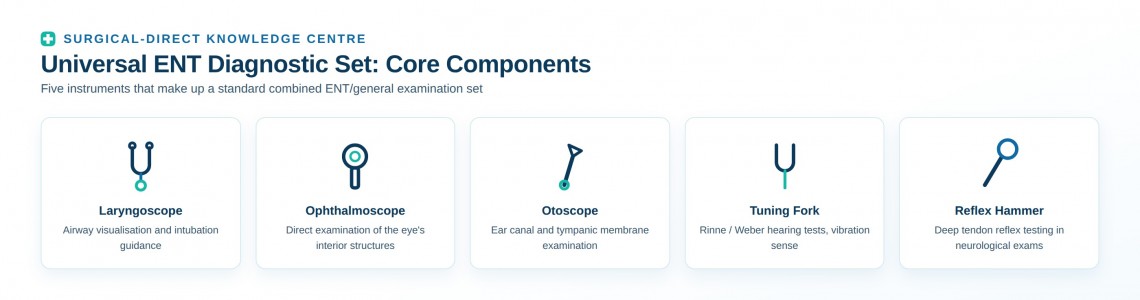
Accurate diagnosis is the first step in every clinical pathway, and the instruments used to reach it need to be reliable, correctly specified, and appropriate to the exam being performed. This guide covers the core instrument families in a standard ENT and general diagnostic exam kit — otoscopes, ophthalmoscopes, laryngoscopes, tuning forks and reflex hammers — and how hospitals, clinics, universities and distributors should think about selecting and procuring them.
What Diagnostic Instruments Are Used For in Clinical Practice
Diagnostic instruments are the tools a clinician reaches for before any treatment decision is made: examining the ear canal and tympanic membrane, assessing the optic disc and retina, checking the airway before intubation, or testing hearing and nerve function during a physical exam. Because they are used on every patient, often several times a day, institutions typically need a wider working stock of these instruments than they do for many single-procedure surgical items. Getting specification right at the procurement stage — the right body type, blade type, size or frequency — avoids delays and repeat ordering later.
Otoscopes: Body Type and Fitting
An otoscope illuminates and magnifies the ear canal and tympanic membrane for routine ear examination. The two variables that matter most for institutional buyers are body construction and light source. Fibre-optic models, such as our Otoscope Fiber Optic Plastic Body, carry light through a fibre-optic bundle to the tip for a brighter, more even field of view than a standard bulb-tip design, and are supplied with a carrying pouch for ward or clinic use. Reusable specula (the disposable or autoclavable cone tips that contact the ear canal) should be ordered in a range of sizes to fit paediatric through adult patients — a common oversight is ordering the otoscope body without enough spare specula to keep pace with clinic throughput.
Ophthalmoscopes: Metal vs. Plastic Body
A direct ophthalmoscope is used to examine the optic disc, retina and red reflex. Institutional buyers choose primarily between a metal-body and a plastic-body instrument. A metal-body ophthalmoscope, such as our Ophthalmoscope Metal Body with pouch, is the more durable option for a busy ward or teaching hospital where the instrument is handled by many different users and needs to withstand repeated use and sterile handling. A plastic-body set, such as our Ophthalmoscope Set Black Plastic Body, is a lighter-weight, typically lower-cost option well suited to a personal kit, a single clinician's office, or a teaching lab issuing sets to individual students. Both function on the same optical principle; the choice is largely one of durability, weight and who will be using the instrument.
Laryngoscopes: Choosing the Right Blade Type
A laryngoscope blade's job is to give a clear line of sight to the vocal cords during intubation. The three blade types most commonly stocked by hospitals and teaching institutions each do this differently, and most airway trolleys carry more than one type to cover different patients and different anaesthetists' preferences.
Macintosh (curved) blades are the standard first choice for adult airway management. The curved tip sits in the vallecula (the space in front of the epiglottis) and indirectly lifts the epiglottis out of the way as the blade is advanced. Their shape gives more room for tube passage than a straight blade, which is why they are the default blade type on most general adult airway trolleys.
Miller (straight) blades are designed to pass under and directly lift the epiglottis itself, rather than working indirectly from the vallecula. This direct-lift approach is why straight blades remain the preferred choice for neonatal and paediatric intubation, where a proportionally larger, floppier epiglottis is harder to control indirectly, and why they are also kept in stock for adult cases with anatomy that makes a Macintosh blade less effective.
McCoy blades are a hinged-tip variant of the Macintosh design: the last part of the blade articulates via a lever operated from the handle, letting the clinician actively lift the epiglottis with less force on surrounding tissue. They are widely stocked as the difficult-airway option — useful when a standard Macintosh blade does not give an adequate view.
Blade sizing. Sizes 00 and 0 cover premature and full-term neonates; size 1 covers infants; size 2 covers young children; size 3 is the standard size for most average-sized adults; size 4 covers larger adults. A complete adult set (Macintosh or fibre-optic Macintosh, blades 1–4) covers paediatric through large-adult use on a single handle system; neonatal units and paediatric hospitals should stock Miller blades in sizes 00, 0 and 1 in addition to an adult Macintosh set.
Tuning Forks for Clinical Hearing and Vibration Testing
Tuning forks remain a fast, low-cost, reusable first-line tool for two very different bedside assessments, and the correct frequency depends on which one is being performed.
Hearing assessment (Rinne and Weber tests). These two tests compare air conduction and bone conduction to help distinguish conductive from sensorineural hearing loss. A mid-to-higher frequency fork is generally preferred for this purpose because it strikes the best balance between audibility and an appropriately long decay time — institutions building or restocking an ENT exam kit typically hold 256 Hz and 512 Hz forks for this reason, with 512 Hz the more commonly recommended default for Rinne and Weber testing specifically.
Vibration and proprioception testing. As part of a neurological exam, a lower-frequency fork is used to test a patient's ability to feel vibration, most often over a bony prominence. A 128 Hz fork is the standard choice for this purpose, since its longer, lower-frequency vibration is easier for a patient to distinguish from a light-touch sensation.
Higher-frequency options. 1024 Hz forks are also stocked by some institutions for specific higher-frequency screening protocols, though used less frequently in general practice than 128 Hz, 256 Hz and 512 Hz. Exact protocol and frequency choice should always follow the institution's own clinical guidelines; this section is procurement guidance on what is typically stocked and why, not a clinical protocol.
Reflex and Percussion Hammers
A percussion (reflex) hammer is used to elicit deep tendon reflexes as part of a neurological exam. Institutional buyers typically choose between a few well-established patterns: the Taylor Percussion Hammer, a triangular rubber head on a flexible handle and one of the most widely used general-purpose patterns; the Rabiner Percussion Hammer, supplied with an integrated needle and brush for combined reflex, pain and light-touch sensory testing in a single instrument; and the NHP Patella Tendon Percussion Hammer, a larger, weighted head pattern favoured for patella (knee-jerk) reflex testing specifically. A teaching hospital or neurology department benefits from stocking more than one pattern, since some examiners prefer the added sensory-testing function of a combined instrument like the Rabiner over a single-purpose hammer.
Building a Standard ENT / General Diagnostic Exam Kit
A well-stocked diagnostic tray for a general ward, ENT clinic or teaching lab typically combines: an otoscope with a range of specula sizes; an ophthalmoscope (metal body for shared ward use, plastic body for individual kits); a Macintosh laryngoscope set (blades 1–4) for adult airway assessment and training, plus Miller blades in neonatal/infant sizes where paediatric patients are seen; a small set of tuning forks spanning 128 Hz, 256 Hz and 512 Hz; and at least one percussion hammer pattern. Teaching hospitals and universities training students in physical examination technique often standardise on exactly this combination so that every student works with the same equipment.
Institutional Procurement Considerations
Because diagnostic instruments are used constantly and across many departments, institutions should think about total working stock, not just one of each item: enough otoscope specula and laryngoscope blades that a full set is never out of service for cleaning or repair at the same time, and enough tuning forks and hammers that a dropped or damaged instrument does not interrupt a teaching clinic or ward round. For bulk or recurring institutional orders, current stock levels, and quotations sized to a department's real throughput, our team can prepare a formal quotation against your specification — request a quote or see our Procurement Guide for Medical Institutions for the broader institutional buying process.
Frequently Asked Questions
What is the difference between a metal-body and plastic-body ophthalmoscope?
Metal-body ophthalmoscopes are more durable and better suited to shared use in a busy ward or teaching hospital; plastic-body sets are lighter and typically lower-cost, well suited to an individual clinician's kit or a teaching lab issuing sets to students.
What is the difference between a Macintosh and a Miller laryngoscope blade?
A Macintosh blade is curved and lifts the epiglottis indirectly from the vallecula; a Miller blade is straight and lifts the epiglottis directly. Macintosh is the standard adult choice; Miller is preferred for neonatal/paediatric use and certain difficult-airway cases.
What laryngoscope blade size do I need for a neonate?
Size 00 or 0 Miller blades are the standard choice for premature and full-term neonates respectively; size 1 covers infants.
Which tuning fork frequency should I use for a hearing test?
256 Hz and 512 Hz forks are the most commonly stocked for Rinne and Weber hearing tests, with 512 Hz the more commonly recommended default. Always follow your institution's own clinical protocol.
What is the difference between a Taylor and a Rabiner percussion hammer?
A Taylor hammer is a general-purpose triangular-head pattern for standard reflex testing; a Rabiner hammer adds an integrated needle and brush, allowing combined reflex and sensory (pain/light-touch) testing with one instrument.
Can Surgical-Direct supply a complete diagnostic exam kit for a teaching hospital?
Yes. Otoscopes, ophthalmoscopes, laryngoscope sets, tuning forks and percussion hammers are all available, including bulk quantities for cohort teaching kits — see our Diagnostic Instruments category for current stock or request a quotation for a standardised student kit.
Can Surgical-Direct repair or refurbish diagnostic instruments I already own?
Yes - our in-house Instrument Workshop & Repair Services provides repair, refurbishment and passivation for existing reusable diagnostic instruments such as laryngoscope blades and handles, metal-body ophthalmoscopes and percussion hammers, restoring them to reliable working condition for hospitals, clinics and teaching institutions maintaining current stock rather than replacing it.
Related Resources
For airway and ENT-specific instruments beyond this core diagnostic kit, see our ENT Surgical Instruments: Complete Guide. For a broader overview of selecting surgical and diagnostic instruments as an institutional buyer, see our Surgical Instruments Buying Guide. Browse current otoscopes, ophthalmoscopes, laryngoscopes, tuning forks and percussion hammers in our Diagnostic Instruments category.
Leave a Comment