
ENT Surgical Instruments: Complete Guide for Hospitals, Clinics and Medical Universities
Ear, nose and throat (ENT) surgery relies on some of the most precise and varied instrument sets in all of surgery. A single ENT tray can include delicate microsurgical picks for the middle ear, robust nasal forceps for sinus work, and general surgical instruments — scissors, needle holders, retractors — shared with almost every other surgical discipline. For hospital procurement teams, clinic owners and university teaching-hospital administrators, understanding this instrument landscape is the difference between a well-equipped ENT department and one that is constantly improvising with the wrong tool for the job.
This guide is written for exactly that audience: people responsible for specifying, sourcing, and maintaining ENT instrument sets, rather than for surgeons choosing technique. It covers the instrument families you will encounter, the procedures they support, how to judge instrument quality, the materials debate between stainless steel and tungsten carbide, and the sterilization and care routines that determine how long an instrument actually lasts in daily hospital use.
Table of Contents
- ENT Instrument Families
- Understanding ENT Instrument Naming Conventions
- ENT Instruments for Medical Universities and Teaching Hospitals
- Common ENT Procedures and the Instruments They Require
- Choosing Quality ENT Instruments
- Stainless Steel in Surgical Instruments
- Tungsten Carbide Inserts
- Care and Maintenance
- Sterilization
- Buyer Guide: What to Specify Before You Order
- Frequently Asked Questions
- Conclusion
ENT Instrument Families
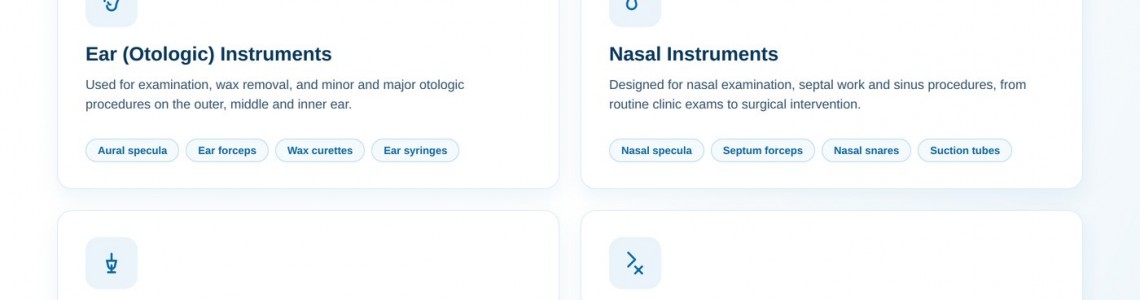
ENT instrument sets are generally organised around the three anatomical regions they serve — ear, nose and throat — plus a fourth category of general surgical instruments shared across all three. The diagram below summarises this classification.

Ear (Otologic) Instruments
Ear instruments range from simple diagnostic tools used in every outpatient clinic to fine microsurgical instruments used in the operating theatre. Aural specula open the ear canal for examination or minor procedures. Ear forceps (crocodile, cup and alligator patterns) remove foreign bodies, wax, or debris under direct or microscopic vision. Wax curettes and hooks clear cerumen without damaging the ear canal lining. Ear syringes and irrigation systems flush the canal during wax management. In the operating theatre, otologic sets extend to micro-instruments for tympanoplasty and mastoid surgery, though these highly specialised microsurgical instruments sit outside the scope of a general ENT instrument tray.
Nasal Instruments
Nasal instruments support both clinic-based examination and surgical intervention on the nasal cavity and sinuses. Nasal specula (Killian, Vienna and similar patterns) are the most frequently used instrument in any ENT clinic, opening the nostril for examination or minor procedures. Septum forceps and septal elevators are used in septoplasty and related nasal surgery. Nasal snares remove polyps. Suction tubes of varying calibres clear blood and secretions during both clinic procedures and sinus surgery, keeping the surgical field visible.
Throat & Laryngeal Instruments
Throat and laryngeal instruments support examination and surgery of the pharynx, larynx and upper airway. Laryngoscopes provide direct visualisation of the larynx and vocal cords. Laryngeal mirrors remain a simple, reliable clinic tool for indirect laryngoscopy. Tongue depressors are the most basic but most-used instrument in any ENT or general practice clinic. Tonsil forceps, tonsil snares and adenoid curettes support tonsillectomy and adenoidectomy, two of the highest-volume procedures in ENT surgery worldwide.
General ENT Surgical Instruments
Every ENT surgical tray also draws on the same general surgical instrument families used across other specialties. Scissors in various patterns (straight, curved, sharp/blunt) handle tissue dissection and suture cutting. Needle holders secure sutures during wound closure. Retractors hold back soft tissue to maintain a clear surgical field. Dissecting and tissue forceps grasp and manipulate tissue with precision. Because these instruments see heavy rotation across every surgical list — not just ENT — hospitals typically hold a larger stock of general instruments than of the more specialised otologic, nasal or laryngeal tools. Complete pre-configured trays for common procedures are available as medical surgery sets, which bundle the correct combination of general and ENT-specific instruments for a given procedure into a single order.
Understanding ENT Instrument Naming Conventions
One source of confusion for procurement teams new to surgical instrument ordering is naming: many ENT instruments carry the name of the surgeon or instrument designer who introduced the pattern, rather than a purely descriptive name. A "Hartmann" ear forceps, a "Killian" nasal speculum, a "Boucheron" ear speculum, a "Jobson Horne" probe and a "Tilley's" dressing forceps are all examples of eponymous instruments still in routine clinical use today, decades or in some cases over a century after the pattern was first introduced.
This matters for buyers for two practical reasons. First, the eponym usually identifies a specific shape, angle or working-tip design rather than a brand — a "Hartmann forceps" from one manufacturer and another should be functionally interchangeable if both are made to the correct pattern, even though they are not the same product. Second, surgeons frequently order by eponym out of habit or training background, so procurement teams benefit from keeping a simple cross-reference of the eponymous names their surgical staff actually use against the descriptive catalogue names suppliers list products under. When in doubt, providing both the eponym and the intended use (e.g. "nasal examination speculum, Killian pattern, small") in a purchase order removes any ambiguity before an order is placed.
ENT Instruments for Medical Universities and Teaching Hospitals
Medical universities and teaching hospitals have instrument requirements that differ from a standalone clinic or general hospital department in three specific ways, each worth planning for at the procurement stage rather than discovering mid-semester.
Parallel demand from training and live clinical use. In a teaching environment, instruments are frequently needed simultaneously for structured skills training (on models or in supervised low-stakes settings) and for live clinical procedures. Because these two uses cannot draw from a single shared pool without one starving the other of availability, most teaching hospitals maintain a distinct training-set inventory, often at a lower material specification than the clinical-grade instruments used in live surgery, alongside their standard clinical stock.
Higher instrument turnover and handling wear. Instruments used repeatedly by students still developing fine motor technique typically experience more handling wear — dropped instruments, incorrect hinge stress, tips used against inappropriate surfaces — than the same instruments in the hands of experienced surgical staff. Budgeting for a higher replacement rate on training-designated stock, rather than applying clinical-stock lifespan assumptions, avoids repeated small emergency orders through an academic year.
Curriculum-driven breadth over procedure-driven depth. A hospital department orders instruments in proportion to the procedures it actually performs. A teaching institution, by contrast, often needs a broader representative range of instrument families and patterns — even ones used relatively rarely in that institution's own clinical caseload — simply so students are exposed to the full instrument landscape described in this guide before graduation. This breadth requirement is one of the most common reasons a university's initial ENT instrument order looks different in composition from a hospital department's order of similar total value.
Surgical-Direct supplies both clinical-grade and training-designated ENT instrument stock to medical universities and teaching hospitals, and can build a quotation around a curriculum's instrument-exposure requirements alongside a department's live clinical caseload — contact our team to discuss an institutional order that covers both.
Common ENT Procedures and the Instruments They Require
Procurement planning is easier when instrument requirements are mapped against actual procedure volume. The table below outlines the instrument requirements for the ENT procedures most commonly performed in general hospitals, day-surgery units and teaching hospitals.
| Procedure | Primary Instruments | Typical Setting |
|---|---|---|
| Tonsillectomy / Adenoidectomy | Tonsil forceps, tonsil snare, adenoid curette, mouth gag, dissecting scissors | Hospital operating theatre |
| Myringotomy / Grommet insertion | Aural speculum, myringotomy knife, micro forceps, suction | Day surgery / outpatient theatre |
| Septoplasty | Nasal speculum, septal elevator, septum forceps, scissors, needle holder | Hospital operating theatre |
| Functional Endoscopic Sinus Surgery (FESS) | Nasal endoscope (imaging equipment), sinus forceps, suction, nasal snare | Hospital operating theatre |
| Foreign body removal (ear/nose) | Aural/nasal speculum, crocodile forceps, hook, irrigation syringe | Outpatient clinic / emergency department |
| Direct laryngoscopy / biopsy | Laryngoscope, biopsy forceps, suction, tongue depressor | Hospital operating theatre |
Beyond the six procedures above, ENT departments also carry a steady baseline of outpatient clinic activity — wax removal, epistaxis (nosebleed) management, foreign body removal, and diagnostic examination — that consumes general-purpose instruments (specula of all three types, basic forceps, suction) at a far higher rate than any single surgical procedure. Procurement plans that focus only on operating-theatre procedure counts and overlook this outpatient baseline frequently under-order the most basic, highest-turnover items on the list.
Medical universities and teaching hospitals typically require duplicate sets across all of the categories above, since students train in parallel with live clinical lists and instruments need to be available for both simultaneously — a factor worth building into initial order quantities rather than discovering mid-semester (see the dedicated section on teaching-hospital requirements above).
Choosing Quality ENT Instruments
Instrument quality is not always visible on a spec sheet, but several concrete markers separate genuinely premium surgical-grade instruments from lower-grade alternatives:
- Consistent, correct grade steel — surgical-grade stainless steel (see below) that resists corrosion through repeated autoclave cycles, not a cosmetically similar but lower-grade alloy.
- Precision-ground working tips — jaws, blades and tips that meet cleanly with even pressure along their full length, rather than gapping at the tip (a common early failure point in lower-quality forceps and scissors).
- Smooth, consistent box-lock or hinge action — a hinge that opens and closes smoothly without grinding, sticking or lateral play, which affects both surgical control and long-term durability.
- Correct heat treatment and hardness — instruments that hold an edge or a spring tension appropriately for their function, rather than dulling or losing tension after a handful of sterilization cycles.
- Clean, consistent finishing — a uniform satin or mirror finish with no visible pitting, tool marks or rough edges, which both indicates manufacturing quality and reduces the surface irregularities where bioburden can lodge.
- Manufacturer traceability — a named, established manufacturer standing behind the instrument, rather than an unbranded or unverifiable source, particularly important for institutional and government procurement documentation.
Surgical-Direct sources its ENT instrument range from established, quality-audited surgical instrument manufacturers, selected specifically to meet institutional and hospital-grade specification requirements.
Stainless Steel in Surgical Instruments
The overwhelming majority of ENT and general surgical instruments are made from martensitic or austenitic stainless steel, most commonly grades in the 420 and 410 series for the martensitic (hardenable, used for cutting edges and box-locks) family. Martensitic stainless steel can be heat-treated to a specific hardness, which is why it is the standard choice for scissors, needle holders and forceps that need to hold a cutting edge or consistent spring tension through hundreds of sterilization cycles.
Quality stainless steel surgical instruments should demonstrate three properties simultaneously: sufficient hardness to hold an edge or working tension, sufficient corrosion resistance to survive repeated steam sterilization without pitting or staining, and enough ductility that the instrument does not become brittle and crack under normal surgical use. Reputable manufacturers balance these three properties through controlled alloy composition and heat treatment; lower-grade instruments often sacrifice corrosion resistance or ductility to hit a lower price point, which shows up as premature rusting or hinge failure within the first one to two years of hospital use rather than at the point of sale.
| Steel Type | Typical Use | Key Characteristic |
|---|---|---|
| Martensitic (410/420 series) | Scissors, needle holders, forceps with a box-lock or spring action | Hardenable by heat treatment; holds a cutting edge and consistent spring tension |
| Austenitic (300 series) | Retractors, non-cutting handling instruments, some instrument casing components | Higher corrosion resistance; not hardenable in the same way, so rarely used for cutting edges |
This is why a mixed-material instrument tray is normal rather than a sign of inconsistent quality: the martensitic grades used for a pair of scissors are selected for a different functional reason than the grades used for a simple retractor, and a well-specified tray uses the correct grade for each instrument's actual mechanical role rather than a single grade throughout.
Tungsten Carbide Inserts
Certain instruments — most commonly needle holders and some scissors — are available with tungsten carbide (TC) inserts fitted into the jaws or cutting edges. Tungsten carbide is significantly harder than stainless steel, and instruments fitted with it are typically marked with a gold-coloured handle ring to distinguish them from standard stainless steel versions on the tray.
For needle holders, tungsten carbide jaw inserts grip suture material and needles more securely with less slippage, and resist wear far longer than stainless steel jaws under repeated use — a meaningful advantage in a high-volume ENT theatre doing multiple procedures per day. For scissors, tungsten carbide cutting edges stay sharp for substantially longer than standard stainless steel blades, reducing the frequency of resharpening or replacement. The trade-off is a higher unit cost, which is why many hospitals stock a mixed inventory: standard stainless steel instruments for lower-frequency use, and tungsten carbide versions concentrated on the highest-rotation instruments in the busiest theatres. Surgical-Direct's full range of TC-inserted instruments across needle holders and scissors patterns is available in the TC Range category.
Care and Maintenance
Instrument lifespan is determined as much by handling and maintenance practice as by the quality of the instrument itself. A few practices materially extend service life:
- Rinse promptly after use — blood and saline left to dry on an instrument accelerates corrosion and makes cleaning significantly harder later.
- Avoid mixing instrument grades in the same ultrasonic bath where possible — galvanic reactions between dissimilar metals can accelerate pitting.
- Lubricate hinges with an instrument-grade, water-soluble lubricant (not general-purpose oil) after cleaning and before sterilization, to preserve smooth action.
- Inspect regularly under magnification for hairline cracks, misaligned jaws, or loss of spring tension, and remove damaged instruments from circulation rather than allowing them to remain in a shared tray.
- Store dry — residual moisture in storage is one of the most common preventable causes of corrosion in otherwise well-maintained instrument stock.
Sterilization
Sterilization is a defined, sequential process rather than a single step, and each stage protects both instrument longevity and patient safety. The diagram below shows the standard central sterile services department (CSSD) cycle used in most hospitals.

Skipping or rushing any single stage in this sequence is a common root cause of both instrument damage and sterility failures. Pre-cleaning at the point of use, in particular, is frequently omitted under time pressure in busy theatres, yet it is the single step that most directly determines how difficult (and how damaging) the later cleaning stage will be. For a detailed reference on healthcare-facility disinfection and sterilization practice, see the CDC Guideline for Disinfection and Sterilization in Healthcare Facilities.
Buyer Guide: What to Specify Before You Order
Institutional buyers — hospital procurement teams, clinic owners, and medical university purchasing departments — get better outcomes when they specify orders precisely rather than ordering by generic category name alone. Before placing an ENT instrument order, confirm the following:
- Exact pattern and size — ENT instruments come in numerous named patterns and length variants; specifying "nasal speculum" without a pattern name leaves room for a mismatch against existing stock or surgeon preference.
- Material grade — standard stainless steel or tungsten carbide-inserted, particularly for needle holders and scissors that will see high rotation.
- Quantity against procedure volume — account for sterilization turnaround time; a single instrument set is rarely sufficient if the same procedure is performed multiple times per day, since instruments must cycle through cleaning and sterilization between uses.
- Individual instruments vs. pre-configured sets — complete medical surgery sets reduce the administrative overhead of ordering each instrument separately for a standard procedure tray.
- Institutional and bulk pricing — hospital, clinic and university orders are typically placed at volumes that justify a direct quotation rather than standard retail pricing.
Surgical-Direct supplies ENT instruments directly to hospitals, clinics and medical universities, with quotations built around actual order volume and specification. Institutional buyers can review the full ENT Instruments category or contact our team directly to request a quotation against a specific instrument list.
For otoscopes, ophthalmoscopes, laryngoscope blade selection, tuning fork frequency selection and reflex/percussion hammers — the core general diagnostic exam kit alongside these ENT-specific instruments — see our Diagnostic Instruments: Complete Guide.
Frequently Asked Questions
What is the difference between stainless steel and tungsten carbide ENT instruments?
Standard instruments are made entirely from surgical-grade stainless steel. Tungsten carbide (TC) instruments have small inserts of the much harder tungsten carbide material fitted into the working jaws or cutting edges — typically identified by a gold handle ring — giving longer-lasting sharpness and grip at a higher unit cost.
How many times can a surgical instrument be sterilized before it needs replacing?
There is no single universal number; it depends on the instrument type, material grade, and how well care and maintenance practices (see above) are followed. Quality stainless steel instruments in a well-run CSSD routinely withstand several hundred autoclave cycles, but any individual instrument should be retired as soon as inspection shows damage, corrosion, or loss of function, regardless of cycle count.
Do all ENT instruments need to be autoclaved, or are some single-use?
Most core ENT instruments — specula, forceps, scissors, needle holders, curettes — are reusable and designed for repeated steam sterilization. Certain disposable items (some suction tips, specific biopsy consumables) are single-use by design; buyers should confirm reusability status per item rather than assuming an entire tray is either fully reusable or fully disposable.
What quantity of each instrument should a new ENT clinic or department order?
This depends on expected procedure volume and sterilization turnaround, but as a general principle, high-rotation general instruments (scissors, needle holders) typically need to be stocked in greater quantity than lower-frequency specialised instruments. Teaching hospitals should also account for duplicate sets required for simultaneous training and clinical use. Our team can help size an initial order against expected caseload — get in touch to discuss your requirements.
Can Surgical-Direct supply a complete ENT instrument set rather than individual items?
Yes. Pre-configured procedure-specific sets are available under Medical Surgery Sets, and individual ENT instruments can also be combined into a custom quotation for hospitals and clinics with specific tray requirements.
Why do some ENT instruments have a surgeon's name attached, such as "Hartmann" or "Killian"?
Many ENT instruments are named after the surgeon or designer who introduced that specific pattern, sometimes over a century ago. The eponym identifies a particular shape or working-tip design rather than a brand, and different manufacturers can each produce an instrument to the correct "Hartmann" or "Killian" pattern. See the naming conventions section above for guidance on ordering by eponym without ambiguity.
What is the difference in instrument requirements between a hospital department and a medical university?
A hospital department orders instruments in proportion to the procedures it actually performs, while a medical university typically needs a broader representative range of instrument families and patterns so students are exposed to the full instrument landscape during training, plus separate training-designated stock to avoid competing with live clinical demand. See the dedicated section on medical university and teaching hospital requirements above for detail.
Can Surgical-Direct repair or refurbish ENT instruments I already own?
Yes - our in-house Instrument Workshop & Repair Services provides repair, resharpening and passivation for existing ENT instruments - forceps, scissors, curettes and specula - restoring them to reliable working condition for hospitals, clinics and teaching institutions maintaining current stock rather than replacing it.
Conclusion
A well-equipped ENT department depends on matching the right instrument — in the right pattern, material grade and quantity — to the procedures actually being performed, and then protecting that investment through consistent care and sterilization practice. Whether you are equipping a new clinic, expanding a hospital ENT department, or supplying a medical university training programme, Surgical-Direct supplies the full range of ear, nose, throat and general surgical instruments covered in this guide. Browse the ENT Instruments category, explore related instrument families in Scissors, Needle Holders and the TC Range, or contact our team directly to request an institutional quotation.
Leave a Comment