
Surgical Instruments Buying Guide: Diagnostic Tools, Forceps, Clamps, Needle Holders and Retractors Explained
What Are General Surgical Instruments?
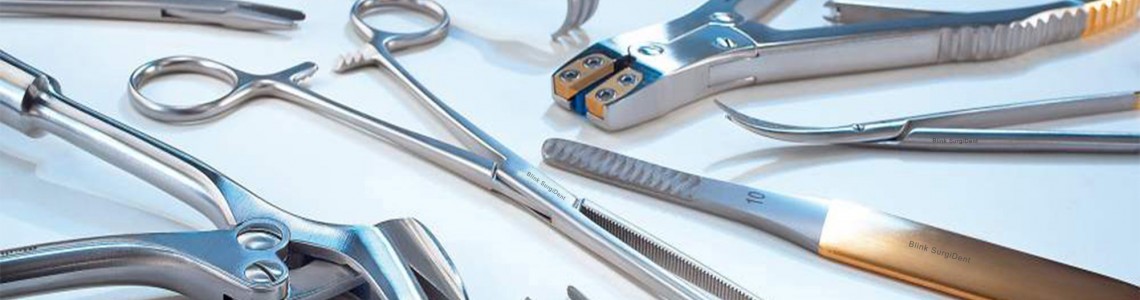
"General surgical instruments" is the working category for the hand instruments used across almost every operating theatre, treatment room and teaching lab — diagnostic tools, dissecting forceps, artery/hemostatic forceps, needle holders and retractors. Unlike specialty sets built for one procedure type, these are the instruments a hospital, clinic, university or distributor needs in volume, across departments, every day. This guide covers what each category is for and what to look at when specifying or re-stocking them. For cutting instruments specifically, see our dedicated Surgical Scissors Buying Guide.
Diagnostic Instruments: Purpose and Selection
Diagnostic instruments are the first tools used in a patient examination — items such as probes, specula and basic examination sets that support assessment before any procedure begins. Because they are used at high volume across outpatient and ward settings, the priorities when specifying them are consistent sizing, a comfortable grip, and a finish that holds up to repeated sterilization cycles without pitting or discolouration. Browse the full range in our Diagnostic Instruments category.
For a full breakdown of otoscopes, ophthalmoscopes, laryngoscope blade types and sizing, tuning fork frequency selection, and reflex/percussion hammers, see our dedicated Diagnostic Instruments: Complete Guide.
Dissecting Forceps: Toothed vs Non-Toothed
Dissecting (tissue) forceps are used to hold, stabilise or manipulate tissue during a procedure, and the first choice to make is toothed versus non-toothed (plain) jaws. Toothed forceps grip tougher tissue — skin, fascia — securely with minimal slippage, at the cost of being more traumatic if used on delicate structures. Non-toothed forceps distribute pressure over a wider surface and are the safer choice for handling delicate tissue, vessels or bowel. Many theatres stock both patterns in more than one length, since a longer forceps is easier to control in a deeper surgical field. See the full range in our Dissecting Forceps category.
Forceps Clamps (Artery / Hemostatic Forceps): Types and Locking Mechanisms
Forceps clamps — commonly called artery or hemostatic forceps — are used to clamp blood vessels and control bleeding during a procedure. The defining feature is the ratcheted locking box, which holds the jaws closed under tension without the user needing to keep squeezing. Curved patterns are generally used for deeper or less accessible vessels, while straight patterns suit vessels closer to the surface. Jaw serration (fine transverse serrations versus longer, coarser patterns) affects how securely the forceps holds tissue versus how much crush trauma it causes, so procedure type should drive the choice. Explore the range in our Forceps Clamps category.
Needle Holders: Jaw Types and Sizing
Needle holders are used to grip a suturing needle securely while it passes through tissue. Jaw design is the key specification: tungsten-carbide-inserted jaws hold the needle far more securely than plain stainless-steel jaws and resist wear over thousands of uses, which is why TC needle holders are the standard choice for high-volume theatres. Length should match the depth of the surgical field — a shorter holder gives better tactile control in superficial work, while a longer holder is needed for deeper cavities. See our Needle Holder category, and read more about tungsten carbide construction in the section below.
Retractors: Hand-Held vs Self-Retaining
Retractors hold back tissue, organs or wound edges to give the surgical team a clear working view. Hand-held retractors (blunt or sharp, single- or double-ended) require an assistant to hold tension throughout the procedure, and are chosen for their simplicity and low profile in a crowded field. Self-retaining retractors use a ratchet or spring mechanism to hold their own position, freeing up an extra pair of hands — a genuine efficiency gain in smaller theatres or where staffing is limited, at the cost of a larger footprint in the wound. Browse the range in our Retractor category.
Tungsten Carbide (TC) Instruments: Why the Insert Matters
Tungsten carbide (TC) instruments have small tungsten carbide inserts brazed into the working tips of an otherwise stainless-steel instrument — most commonly on needle holder jaws and scissor blades. Tungsten carbide is significantly harder than stainless steel, so a TC instrument holds its grip and cutting edge far longer under repeated sterilization and use, and the inserts are usually gold-coloured so the instrument is easy to identify at a glance during a busy case. TC instruments cost more up front than an all-steel equivalent, but for high-frequency-use instruments the extended service life is generally the deciding factor for institutional buyers. See the full range in our Tungsten Carbide (TC) Surgical Instruments category.
Materials and Finish: Stainless Steel and Passivation
Almost all general surgical instruments are made from surgical-grade stainless steel, chosen because it is non-magnetic, corrosion-resistant and can withstand repeated autoclave sterilization without degrading. Passivation — a chemical treatment that removes free iron from the surface and builds a protective oxide layer — is what keeps a stainless steel instrument from rusting or staining over years of reprocessing, so it's worth confirming with any supplier that instruments are passivation-processed rather than just polished. Finish (satin/matte versus mirror-polish) is largely a preference and glare-control choice under theatre lighting rather than a functional difference.
Choosing the Right Instrument Set for Your Facility
For most hospitals, clinics and training institutions, the practical approach is to standardise on a small number of proven patterns per category — one or two dissecting forceps patterns, one or two artery forceps patterns, a TC needle holder in two lengths, and a small set of hand-held and self-retaining retractors — rather than stocking every available variant. This keeps sterilization trays predictable, makes staff training faster, and simplifies re-ordering. Universities and training programmes often add a wider variety of patterns deliberately, so students are exposed to the full range before specialising. Distributors and dealers sourcing for multiple end-customers should request our institutional quotation process (below) to get accurate volume pricing before committing to a standard set.
Care, Sterilization and Maintenance
Instruments should be rinsed promptly after use to prevent blood and tissue debris from drying onto the surface, cleaned (commonly by ultrasonic cleaning) before sterilization, inspected for damage to jaws, tips and box locks, and lightly lubricated at hinge points with an instrument-safe lubricant compatible with your sterilization method. Ratcheted instruments — forceps clamps and needle holders — should be sterilized in the open, unlocked position so steam can reach the box lock and the ratchet teeth aren't left under tension between uses.
Common Mistakes When Selecting General Surgical Instruments
The most frequent mistakes we see from institutional buyers are: standardising on a single forceps pattern for all tissue types (toothed forceps used on delicate tissue causes avoidable trauma); under-ordering needle holder lengths, leaving staff without the right reach for deeper fields; treating all stainless steel as equivalent regardless of passivation quality; and choosing plain-jaw needle holders for high-volume suturing work where a TC insert would pay for itself in service life within the first year or two of use.
Institutional Procurement Considerations
Surgical-Direct supports hospitals, universities, government departments, distributors, dealers and clinics with formal quotation requests across the full general surgical instruments range, including volume and institutional pricing. If you're specifying a full instrument set rather than individual items, our Hospital Procurement Guide for Surgical Instrument Sets covers the broader RFQ, purchase order and turnaround process. To request pricing on any items covered in this guide, visit our Request a Quotation page, which includes a dedicated institutional procurement FAQ.
Frequently Asked Questions
What is the difference between dissecting forceps and forceps clamps?
Dissecting forceps are used to hold and manipulate tissue by hand pressure alone; forceps clamps (artery/hemostatic forceps) have a ratcheted locking box that holds the jaws closed under tension, typically to clamp a blood vessel without the user needing to keep holding it.
Why do some needle holders and scissors have a gold-coloured insert?
The gold colour identifies a tungsten carbide (TC) insert brazed into the jaws or blades. TC is harder than stainless steel, so it holds its grip or cutting edge longer under repeated use and sterilization.
How many forceps patterns does a general theatre actually need?
Most facilities standardise on one or two toothed and one or two non-toothed dissecting forceps patterns, in more than one length, rather than stocking every available variant — this keeps sterilization trays predictable and simplifies staff training.
Should ratcheted instruments be sterilized locked or unlocked?
Unlocked. Sterilizing forceps clamps or needle holders in the open position lets steam reach the box lock and ratchet teeth, and avoids leaving the ratchet under tension between uses.
Do you supply general surgical instruments in bulk for institutional buyers?
Yes — hospitals, universities, government departments, distributors, dealers and clinics can request a formal quotation with volume/institutional pricing through our Request a Quotation page.
Can Surgical-Direct repair or refurbish forceps, needle holders or retractors we already own?
Yes - our in-house Instrument Workshop & Repair Services provides repair, refurbishment and passivation for existing dissecting forceps, artery forceps, needle holders and retractors, restoring current stock to reliable working condition for hospitals, clinics, universities and distributors maintaining existing inventory rather than replacing it.
Related Articles
Explore our Surgical Instruments category, or read our Surgical Scissors Buying Guide and Hospital Procurement Guide for Surgical Instrument Sets. For a dedicated breakdown of bone levers, taps, chisels, curettes, rongeurs, saws and plaster shears, see our Orthopedic Surgical Instruments Buying Guide. For ophthalmic-specific instruments — speculums, micro forceps, retractors, cannulas and needle holders — see our Ophthalmic Surgical Instruments Buying Guide. For gynecological instruments — vaginal specula, uterine dilators, curettes and obstetric forceps — see our Gynecological Surgical Instruments Buying Guide. For ophthalmic-specific instruments — speculums, micro forceps, retractors, cannulas and needle holders — see our Ophthalmic Surgical Instruments Buying Guide.
Leave a Comment